Best New AI Tools 2026 Free: 10 Powerful AI Tools You Can Use for Free
Artificial intelligence is transforming how people work, learn, create content, run businesses, and solve everyday problems. In 2026, AI tools are becoming increasingly accessible, allowing students, freelancers, entrepreneurs, marketers, developers, and content creators to complete tasks that once required expensive software or specialized technical skills.
The good news is that you do not need a large budget to benefit from artificial intelligence. Many AI platforms offer free plans, free trials, or limited free usage that can help you write articles, generate images, summarize documents, create videos, build websites, analyze information, and automate repetitive tasks.
If you are searching for the best new AI tools 2026 free, this comprehensive guide will help you discover useful platforms, understand what they do, and choose the right tools for your needs.
Whether you want to start a blog, improve your productivity, create professional-looking graphics, learn a new skill, or build an online business, there is likely a free AI tool that can help.
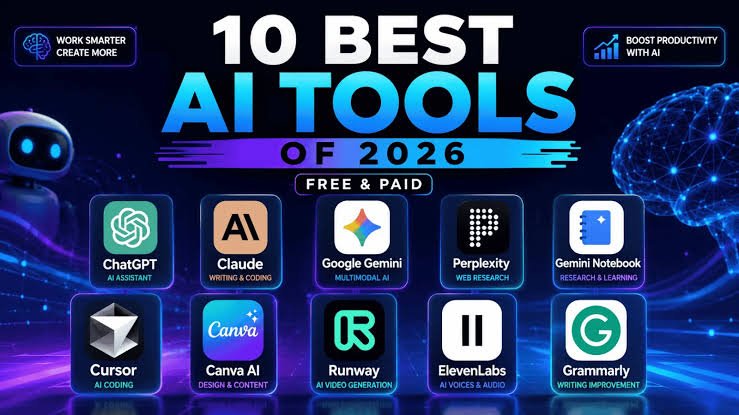
This article covers 10 AI tools across different categories, explains their key features, identifies who can benefit from them, and shares practical tips for getting the most value from free plans.
Important note: A tool being free does not necessarily mean every feature is free. Pricing, usage limits, model access, and regional availability can change. The platforms below are established options worth exploring in 2026; not every one is a newly launched product. Check each provider’s current pricing page before relying on a particular feature.
What Are the Best New AI Tools in 2026?
The best free AI tools in 2026 are applications that use artificial intelligence to simplify work, improve creativity, answer questions, generate content, or automate tasks without requiring a substantial upfront investment.
Some tools specialize in one activity, such as image generation or transcription. Others combine several capabilities in a single workspace.
For example, an AI assistant can help you brainstorm an article, a writing tool can improve its structure, an image generator can create a featured illustration, and an SEO platform can help you research relevant keywords.
The most useful AI toolkit depends on your goals. A student may prioritize research and note-taking, while a YouTube creator may need video editing, voice generation, and thumbnail design.
When choosing an AI platform, consider these factors:
- Free access: Does the platform provide a usable free plan?
- Features: Can it perform the tasks you actually need?
- Ease of use: Can beginners use it without extensive technical knowledge?
- Output quality: Are the results accurate, useful, and professional?
- Usage limits: How many prompts, generations, or exports can you complete?
- Privacy: How does the provider handle your uploaded files and personal information?
- Commercial rights: Are you allowed to use the generated content for business purposes?
With these criteria in mind, let’s explore the best free AI tools to try in 2026.
1. ChatGPT — Best Free AI Assistant for Everyday Tasks
Best for: Writing, brainstorming, learning, planning, research assistance, and productivity.
ChatGPT is one of the most versatile AI assistants available. It can help users generate ideas, draft articles, explain complex topics, create outlines, summarize text, write emails, and solve problems.
For bloggers and digital marketers, ChatGPT can be especially useful during the content planning process. You can use it to develop article outlines, generate headline variations, identify questions readers might ask, and rewrite complicated explanations in simpler language.
Students can use it to understand difficult concepts, practice languages, and develop study plans. Business owners can use it to draft proposals, organize ideas, and create customer support templates.
What can you do for free?
Depending on the current free-plan limits, you may be able to access AI conversations, file or image-related features, and other supported capabilities with usage restrictions.
Example prompt: “Create a detailed SEO article outline about affordable website hosting for beginners. Include search intent, related keywords, frequently asked questions, and a practical conclusion.”
Why it is useful: ChatGPT can serve as the central assistant in your AI workflow, helping you plan and organize work before using more specialized tools.
Website: https://chatgpt.com/
2. Google Gemini — Best Free AI Tool for Google’s Ecosystem
Best for: General assistance, brainstorming, learning, and working with supported Google services.
Google Gemini is an AI assistant that helps users answer questions, summarize information, draft content, and explore ideas. Its integration with Google’s ecosystem can make it useful for people who already work with services such as Gmail, Google Docs, and Google Drive, where supported features and account eligibility allow.
Gemini can assist with study notes, business planning, explanations, creative writing, and everyday productivity.
For example, a small business owner could ask it to develop a customer feedback questionnaire, suggest social media post ideas, or turn a rough business concept into a structured plan.
Free-plan advantage: Eligible users can access Gemini without necessarily subscribing to a paid AI plan, although model access, limits, and connected-app features may vary.
Who should use it? Students, professionals, entrepreneurs, and anyone who wants an alternative AI assistant for everyday tasks.
Website: https://gemini.google.com/
3. Claude — Best AI Tool for Long-Form Writing and Analysis
Best for: Detailed writing, document analysis, editing, and structured reasoning.
Claude, developed by Anthropic, is an AI assistant known for its usefulness in writing-intensive and analytical workflows.
It can help you draft long-form content, refine a business proposal, summarize a report, analyze text, and improve the clarity of existing material.
For SEO writers, Claude can be helpful when developing detailed explanations, comparing ideas, or improving the flow of an article. You should still verify factual claims, add original insights, and make sure the final article satisfies the searcher’s needs.
Example use case: Upload a document where supported and ask the assistant to identify its key arguments, summarize the main findings, and suggest improvements to its organization.
Free access: Claude offers free access in eligible markets, subject to usage limits and current plan availability.
Website: https://claude.ai/
4. Microsoft Copilot — Best Free AI Tool for Microsoft Users
Best for: Everyday questions, writing assistance, idea generation, and supported Microsoft workflows.
Microsoft Copilot is an AI assistant designed to help users search for information, develop ideas, draft text, and complete various productivity tasks.
It can be useful for creating presentation outlines, rewriting professional emails, generating meeting agendas, and explaining technical concepts.
Users who work in Microsoft 365 may also encounter Copilot features within Microsoft applications, although availability can depend on the product, subscription, account type, and organization.
Why try it? Copilot provides another entry point into AI-assisted work, particularly for people who already rely on Microsoft products.
Free-plan consideration: Features available on the standalone service may differ from those included in paid Microsoft subscriptions.
Website: https://copilot.microsoft.com/
5. Perplexity AI — Best Free AI Tool for Research
Best for: Exploring topics, finding source material, and answering research questions.
Perplexity is an AI-powered search and answer platform designed to provide responses supported by web sources.
Rather than simply returning a list of search results, it can organize information into a readable explanation and provide citations that help you investigate the original material.
This can save time when researching unfamiliar topics, preparing reports, comparing technologies, or collecting background information for an article.
However, citations are not a guarantee of accuracy. Open the original sources, verify that they support the claims, and check publication dates when researching changing topics.
Example prompt: “Compare five free AI tools for video editing in 2026. Prioritize official product pages, current free-plan restrictions, and tools suitable for beginners.”
Free-plan consideration: Research features and the availability of advanced models may be limited.
Website: https://www.perplexity.ai/
6. DeepSeek — Best Free AI Tool for Technical Questions
Best for: Technical explanations, coding assistance, mathematics, and analytical tasks.
DeepSeek provides AI models and assistant experiences that can be useful for solving technical problems, exploring programming concepts, and working through structured questions.
Developers can use it to understand unfamiliar code, investigate bugs, generate examples, and compare possible implementation approaches.
Students may find it useful for practicing mathematics or learning technical subjects, provided they use it as a learning aid rather than accepting every answer without checking the reasoning.
What makes it worth exploring? Its accessible assistant experience and model offerings can provide another option for people who want to experiment with AI-powered reasoning and coding.
Availability, performance, data-handling practices, and free usage limits depend on the particular service or model you use.
Website: https://www.deepseek.com/
7. Grok — Best AI Assistant for Exploring Current Conversations
Best for: General questions, idea generation, and exploring supported real-time information.
Grok is an AI assistant associated with the X platform. Depending on the available features and account access, it can help answer questions, summarize topics, generate text, and explore current online conversations.
It may be particularly useful for social media managers, journalists, marketers, and people interested in tracking discussions around emerging topics.
However, information from social media can be incomplete, misleading, or unverified. Confirm important claims through reliable primary sources before publishing them.
Free access: Access and feature limits may vary according to account status, location, and current product policies.
Website: https://grok.com/
8. NotebookLM — Best Free AI Tool for Studying Documents
Best for: Students, researchers, educators, and document-heavy projects.
NotebookLM is an AI research and learning assistant from Google that helps users work with their own source materials.
Depending on supported formats and current limits, you can add documents and other sources, then ask questions about the material, generate summaries, and organize important information.
This makes it particularly useful for exam preparation, literature reviews, project research, and understanding lengthy reports.
For example, a student could upload permitted course notes and ask for a chapter summary, a list of key concepts, or practice questions based on the material.
NotebookLM can also help users distinguish information contained in their sources from the broader background knowledge they may need to research separately.
Free-plan advantage: It has offered a free entry point with usage limits, making it an attractive option for students and independent researchers.
Website: https://notebooklm.google.com/
9. Canva AI — Best Free AI Tool for Graphic Design
Best for: Social media graphics, presentations, posters, marketing materials, and simple visual content.
Canva combines graphic design tools with AI-assisted features that can help users create and edit visual content.
You can use Canva to design blog graphics, YouTube thumbnails, Instagram posts, presentation slides, flyers, and promotional materials without needing professional design experience.
Its AI capabilities may include text generation, image-related tools, layout assistance, and editing features, depending on the current plan.
Practical example: A blogger could create a featured image for an article, prepare Pinterest graphics, and design matching social media posts within the same platform.
Free-plan consideration: Some AI credits, premium templates, stock assets, and advanced tools may require payment.
Website: https://www.canva.com/
10. Adobe Firefly — Best AI Tool for Creative Image Generation
Best for: Generating images, exploring visual concepts, and editing creative assets.
Adobe Firefly offers AI-powered creative features designed to support image creation and editing.
It can be useful for developing campaign concepts, creating visual assets, exploring different artistic directions, and assisting with design workflows.
For content creators, an image generator can reduce the time spent searching for suitable visuals, especially when an article needs a custom illustration.
However, generated images should be reviewed carefully for visual errors, misleading details, and suitability for the intended audience.
Free-plan consideration: Firefly has offered limited free generative access, while additional usage and certain features may require a paid plan.
Website: https://firefly.adobe.com/