Best Free Readability Checker for Essays Online
Writing a good essay involves more than using correct grammar and spelling. An effective essay should also be easy to understand, well organized, and suitable for its intended audience. Whether you are a student, teacher, researcher, or professional writer, checking the readability of your essay can help you communicate your ideas more clearly.
A free readability checker for essays online can help you identify long sentences, difficult words, and complex writing structures. Some tools also provide readability scores that estimate how easy a text is to understand. These results can help you decide whether your essay needs simpler language, shorter sentences, or better organization.
However, not every readability checker offers the same features. Some focus on readability scores, while others combine readability analysis with grammar checking, spelling correction, and writing suggestions.
This guide explains what a readability checker does, the best free tools to consider, how to choose the right option, and how to improve your essay using readability results.
What Is a Readability Checker for Essays?
A readability checker is an online tool that analyzes written content to estimate how easy it is for readers to understand.
It examines features such as sentence length, word complexity, and the number of syllables in words. Depending on the tool, it may also evaluate passive voice, paragraph structure, and other writing patterns.
For example, consider these two sentences:
Difficult sentence: The implementation of effective communication strategies facilitates the improvement of academic comprehension.
Simpler sentence: Good communication strategies help students understand academic material.
The second sentence expresses a similar idea using more familiar words and a simpler structure.
A readability checker can help identify writing that may be unnecessarily difficult. It does not automatically determine whether an essay is good or bad, but it provides useful information for revision.
Students can use these tools to review assignments, improve essays, and make their arguments easier to follow.
Best Free Readability Checker for Essays Online
Several online tools offer free readability analysis. The best choice depends on whether you need a simple readability score, detailed writing feedback, or a combination of features.
1. Readable
Readable is a writing analysis tool that helps users evaluate the readability of written content. Its features are designed to help writers understand how accessible their text may be to different audiences.
The tool uses established readability measures to assess sentence and word complexity. Depending on the available features and plan, users may also find information about other writing characteristics.
Best for: Writers who want to examine the readability of essays and other longer documents.
Main benefit: It focuses on readability analysis rather than treating readability as a minor part of general grammar checking.
Limitation: Some features may require a paid plan, so check which options are available for free before using it for regular assignments.
2. Hemingway Editor
Hemingway Editor is a popular writing tool that highlights sentences and phrases that may be difficult to read.
It identifies issues such as very hard to read sentences, excessive adverb use, and passive voice. It also provides a readability grade to help writers understand the approximate reading level of their text.
The visual highlighting makes it easier to locate areas that may need revision.
For example, if a paragraph contains several long sentences, Hemingway Editor can help you identify them and consider shorter alternatives.
Best for: Students who want to simplify sentence structure and improve clarity.
Main benefit: Its visual feedback makes complex writing easier to identify.
Limitation: It does not replace a complete grammar checker or evaluate the quality of an essay’s argument. Some advanced features may also require payment.
3. Grammarly
Grammarly is a writing assistant that checks grammar, spelling, punctuation, and clarity. Depending on the version and features available, it can also provide feedback on sentence structure and word choice.
Although Grammarly is not exclusively a readability checker, its suggestions can help make essays easier to understand.
For example, it may identify an unclear sentence, suggest a more direct expression, or point out unnecessary wording.
Best for: Students who want to check readability alongside grammar and spelling.
Main benefit: It combines several useful writing checks in one place.
Limitation: Not every writing suggestion or advanced feature is available in the free version. Its readability support may also differ from tools that focus specifically on readability scores.
4. WordCounter
WordCounter is an online writing tool that provides information about text length and other writing characteristics. Depending on the available features, it can help users examine sentence length, word count, and readability statistics.
These measurements can be useful when reviewing essays that have strict word limits or contain sentences that are longer than necessary.
For instance, a student can use word count and sentence length information to identify sections that may benefit from editing.
Best for: Students who need basic text statistics and writing analysis.
Main benefit: It provides useful information about the structure and length of written content.
Limitation: The available readability features may be less detailed than those of a dedicated readability analysis tool.
5. Online Utility Readability Checkers
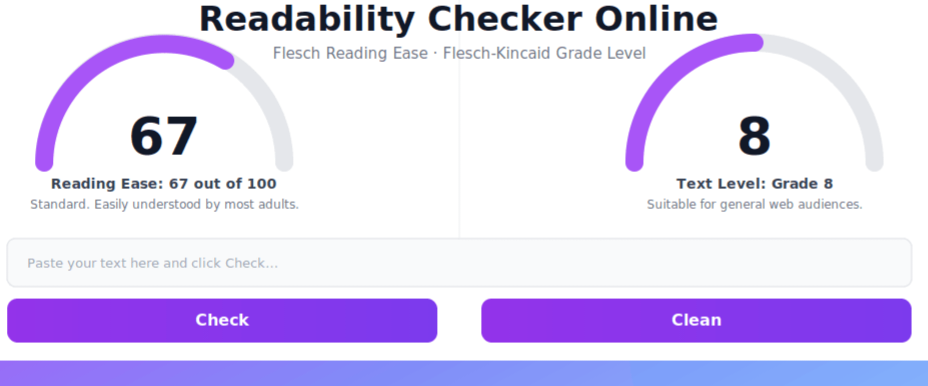
Several websites provide simple readability calculators that analyze pasted text and return a score. These tools often use established formulas, such as the Flesch Reading Ease test or the Flesch Kincaid Grade Level.
They can be useful when you want a quick result without using a full writing assistant.
Most basic readability calculators focus on measurable characteristics of text rather than grammar correction or detailed editing advice.
Best for: Students who need a quick readability score for an essay.
Main benefit: A simple calculator can help you assess sentence and word complexity without a complicated setup.
Limitation: Results may vary between tools, and a numerical score alone cannot show whether your essay communicates its ideas effectively.
Before choosing a tool, check whether it allows free text analysis, supports your essay length, and explains its results clearly.
Which Readability Checker Is Best for Students?
The best free readability checker depends on your main writing goal.
If you want to identify complicated sentences and make your writing more direct, Hemingway Editor is a useful option to consider.
If you want to check grammar, spelling, and clarity together, Grammarly may be more suitable.
If you need a detailed analysis of readability levels, a dedicated readability tool such as Readable may be worth considering, although free access can be limited.
If your main concern is word count and sentence length, WordCounter can provide useful basic statistics.
For students who only need a quick reading difficulty estimate, a simple online readability calculator may be sufficient.
Before settling on a tool, consider whether it supports your type of essay, provides the information you need without payment, and allows you to review your writing without unnecessary steps.
Common Readability Scores Explained
Many readability checkers use formulas to estimate how difficult a text may be to understand. Learning what these scores mean can help you interpret the results correctly.
Flesch Reading Ease
The Flesch Reading Ease score estimates how easy a passage is to read based on sentence length and syllable count.
Read also: How to Generate SEO Friendly Blog Post Outlines Using AI
The score generally ranges from 0 to 100. Higher scores indicate easier text, while lower scores indicate more difficult text.
A score around 60 to 70 is often considered reasonably easy for many general readers. However, the appropriate score depends on the audience and the subject.
An academic essay may require specialized terminology that lowers its readability score without making it unsuitable for its intended readers.
Flesch Kincaid Grade Level
The Flesch Kincaid Grade Level estimates the US school grade level associated with understanding a passage.
For example, a result of grade 8 suggests that the text may be suitable for readers at approximately an eighth grade reading level.
This result is an estimate, not a guarantee that every reader at that grade level will understand the text.
The score can help you decide whether your essay contains unnecessarily complex language, but it should not be the only measure of writing quality.
Other Readability Measures
Some tools use additional formulas, including the Gunning Fog Index and the SMOG Index.
These measures estimate reading difficulty using different combinations of sentence length and word complexity.
Because the formulas work differently, they may produce different results for the same essay. This does not necessarily mean one tool is incorrect.
For consistent results, use the same readability formula when comparing different versions of your essay.
How to Check the Readability of an Essay Online
Checking your essay is usually straightforward. Follow these steps to get useful results.
Step 1: Prepare your essay.
Complete your first draft and check that the text is ready for review. If your essay contains headings, quotations, or references, decide whether they should be included in the analysis.
Step 2: Open a readability checker.
Choose a free tool that supports the length and format of your essay. Confirm whether it offers the features you need without requiring a subscription.
Step 3: Paste your text into the tool.
Copy your essay and place it in the provided text box. Some tools may also allow you to upload documents or analyze text directly in an editor.
Step 4: Review the results.
Look at the readability score, sentence length, difficult words, and any additional feedback. Pay attention to sections that the tool identifies as particularly complex.
Step 5: Edit difficult sentences.
Replace unnecessarily complicated expressions with simpler alternatives. Break long sentences into shorter ones when doing so improves clarity.
For example, instead of writing, “Due to the fact that the experiment produced inconsistent results, additional testing was required,” you could write, “Because the experiment produced inconsistent results, researchers needed to conduct more tests.”
Step 6: Check the essay again.
Run the revised text through the same tool. Compare the results and confirm that your changes have improved clarity without removing important information.
Finally, read the essay yourself. A good readability score does not guarantee that the argument is logical, the evidence is accurate, or the writing meets the assignment requirements.
Tips for Improving Essay Readability
A readability checker can identify potential problems, but improving an essay requires careful editing.
Use Clear and Familiar Words
Choose words that communicate your meaning directly. Avoid using complicated vocabulary simply to make your writing sound academic.
Technical terms are appropriate when they are necessary for the subject. When a term may be unfamiliar to your audience, explain it briefly.
Keep Sentences Manageable
Long sentences can contain several ideas, making them difficult to follow. When a sentence becomes complicated, consider dividing it into two sentences.
However, do not shorten every sentence. A mixture of short and moderately long sentences can create a natural reading rhythm.
Organize Paragraphs Around One Main Idea
Each paragraph should generally develop one central point. Begin with a clear topic sentence, explain the idea, and provide evidence or examples where appropriate.
Use transitions to show how one paragraph connects to the next.
Remove Unnecessary Words
Wordy expressions can make an essay harder to read without adding useful information.
For example, replace “at this point in time” with “now” when the meaning remains the same.
Look for repeated ideas, unnecessary introductory phrases, and expressions that make your sentences longer than necessary.
Use the Appropriate Academic Tone
Simple writing does not mean removing important detail or making every sentence informal.
Academic essays often require precise language, supporting evidence, and subject specific vocabulary. Your goal should be to make these elements understandable without weakening your argument.
Read Your Essay Aloud
Reading aloud can help you identify awkward phrasing, repetitive expressions, and sentences that are difficult to follow.
If you struggle to read a sentence naturally, consider revising its structure.
Combining this technique with a free readability checker can give you a more complete picture of your essay’s clarity.
Are Free Online Readability Checkers Accurate?
Free readability checkers can provide useful estimates, but their accuracy depends on what they measure and how you interpret the results.
Most traditional readability formulas focus on measurable features such as sentence length, word length, and syllable count. They do not fully understand context, reasoning, tone, or the relationship between ideas.
For example, a short sentence may receive a favorable readability score but still communicate an unclear idea. Similarly, a long sentence may be necessary to explain a complex academic concept accurately.
Some tools also treat headings, abbreviations, quotations, and technical terms differently. These differences can affect the final score.
For the best results, use readability scores as guidance rather than strict rules. Combine automated feedback with your own judgment, grammar checks, and the requirements of your assignment.
If you are writing for a specific audience, prioritize whether that audience can understand your main points and follow your argument.
Frequently Asked Questions
1. What is the best free readability checker for essays online?
The best option depends on your needs. Hemingway Editor is useful for identifying difficult sentences, Grammarly helps with grammar and clarity, and basic readability calculators provide quick scores. Check the current free features before choosing a tool.
2. Can I check my essay readability for free?
Yes. Several online tools offer free readability analysis or basic writing feedback. However, some limit the amount of text you can analyze or reserve advanced features for paid plans.
3. What is a good readability score for an essay?
There is no single ideal score for every essay. A Flesch Reading Ease score around 60 to 70 is often considered suitable for general reading, but academic writing may require greater complexity. Always consider your intended audience.
4. Does a readability checker correct grammar mistakes?
Not necessarily. Some tools focus on readability scores, while others combine readability feedback with grammar and spelling checks. If you need both functions, choose a tool that explicitly supports them.
5. Can a readability checker detect plagiarism?
A readability checker does not normally determine whether an essay contains copied material. Plagiarism detection requires a separate tool that compares text with available sources or databases.
6. Should I aim for the highest possible readability score?
No. A higher score does not automatically mean a better essay. Focus on clear explanations, logical organization, accurate information, and language suitable for your readers. Use the score to identify possible improvements rather than as the only measure of quality.